Solawave vs Omnilux 2026: Wand or Mask?
Solawave 4-in-1 Radiant Renewal Wand vs Omnilux Contour Face: price, coverage, wavelengths, and who should buy the under-$250 wand vs the under-$500 mask.
Heads up: this post has affiliate links. We may earn a small commission if you buy something, at no extra cost to you. We only link to stuff we'd actually tell a friend about. Prices shown are approximate and change often; check the retailer for current pricing.
The Solawave 4-in-1 Wand (under $250) and the Omnilux Contour Face (under $500) are both red light devices, but they are not the same product category. Omnilux is a hands-free, FDA-cleared LED mask with 132 LEDs at the researched 633nm + 830nm wavelengths, and it treats your whole face at once. Solawave is a handheld wand with 660nm red light plus galvanic current, warmth, and vibration that you glide manually over one small area at a time. For measurable full-face anti-aging results, Omnilux is worth the extra under $250. Solawave is the pick if you want a low-cost entry point, targeted touch-ups, or a travel-friendly tool.
This is the most common budget-vs-premium question in at-home red light, and the honest answer is that the two devices solve different problems. One is a dose machine; the other is a massage-plus-light multitasker at a quarter of the commitment.
Based on published specs and verified owner reviews, here is how they actually compare.
The spec sheet
| Product | Spec | Solawave 4-in-1 Wand | Rating | Where |
|---|---|---|---|---|
| Price (2026) Omnilux costs about 2.3x more | Under $250 | Under $250 | Under $500 | - |
| Device type Different categories entirely | Handheld wand | Handheld wand | Hands-free flexible mask | - |
| Red light Omnilux adds near-infrared depth | 660nm | 660nm | 633nm + 830nm NIR | - |
| Coverage The biggest practical difference | One small zone at a time | One small zone at a time | Full face at once | - |
| Extras Solawave is a 4-in-1 tool | Galvanic current, warmth, vibration | Galvanic current, warmth, vibration | None, light only | - |
| Session Omnilux works while you do nothing | ~3 min per area, hands-on | ~3 min per area, hands-on | 10 min, hands-free | - |
| FDA clearance Omnilux has aesthetic clearance | General wellness device | General wellness device | Class II 510(k) cleared | - |
| Best for Pick by goal | Entry point, targeted areas, travel | Entry point, targeted areas, travel | Full-face anti-aging results | - |
The core difference: dose and coverage
Red light results depend on cumulative dose: how much light energy your skin receives over weeks of consistent use. Omnilux floods the entire face with 132 LEDs for 10 hands-free minutes. Solawave covers a phone-camera-sized patch of skin at a time, so a full-face session means manually gliding the wand zone by zone. Most people end up giving each area a fraction of the exposure a mask delivers automatically. That is why the mask produces more reliable full-face results.
The Omnilux runs the two most-researched wavelengths in photobiomodulation:
- 633nm (red): fibroblast activation and collagen synthesis
- 830nm (near-infrared): deeper penetration for mitochondrial support
The Solawave wand runs 660nm red light, a solid, well-studied wavelength, but no near-infrared. It compensates with three non-light features:
- Galvanic current: a mild electrical current, gentler than dedicated microcurrent devices
- Therapeutic warmth: helps the wand glide and feels great
- Facial massage vibration: temporary de-puffing along cheekbones and jaw
Those extras are real quality-of-life features. They are also why Solawave reviews often mention the instant de-puffed look, which comes mostly from massage and warmth rather than the light itself.
Effort: the overlooked factor
Omnilux is passive: strap it on, watch TV, done in 10 minutes. Solawave is active: you glide it slowly over each zone with serum on, and a thorough full-face pass takes real attention. Verified owner reviews follow a consistent pattern: wand owners love the first month, then usage drops off because it demands hands-on time. Mask owners keep the habit longer because it asks nothing of them.
With light therapy, the device you still use in month four is the one that works.
Where each one wins
Solawave wins on:
- Price: under $250 vs under $500, the cheapest way to try red light
- Targeted use: crow’s feet, smile lines, forehead, one zone at a time
- Extras: galvanic current, warmth, and massage in one tool
- Portability: pen-sized, USB-C, lives in a travel bag
- Instant gratification: massage and warmth de-puff on day one
Omnilux wins on:
- Full-face coverage: 132 LEDs treat everything at once
- Wavelengths: adds 830nm near-infrared for deeper support
- FDA Class II clearance for aesthetic use
- Research base: the 633/830 protocol cited in dermatology studies
- Zero-effort sessions: hands-free, so compliance survives real life
Which one we’d recommend
If your budget allows it and your goal is visible full-face improvement in lines, firmness, and tone, buy the Omnilux Contour Face. It is the stronger device by dose, depth, and evidence. Buy the Solawave if you are red-light-curious and not ready to spend under $500, you mainly want to target one or two zones, or you want a travel tool to supplement a mask you already own.
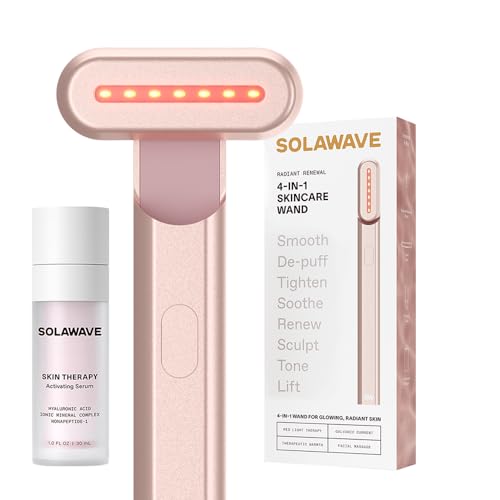
Solawave
4-in-1 Radiant Renewal Wand
660nm red light + galvanic current + warmth + massage in a travel-sized wand.
Best for: Red light beginners, targeted zones, travel
Omnilux
Men LED Face Mask
Omnilux's flexible LED face mask. The Contour Face is out of stock on Amazon, so this links to the Omnilux Men listing.
Best for: Full-face anti-aging, consistent hands-free sessions
The math over a year
- Solawave: under $250 for targeted zones and massage benefits
- Omnilux: under $500 for full-face dose, hands-free
If the wand keeps you consistent for a year, it beats a mask you would not have bought. But if you are choosing one device for measurable anti-aging results, the difference buys roughly 10x the light coverage per session, delivered automatically.
Dig deeper
- Solawave wand full review: what it does and doesn’t do
- Is the Omnilux Contour worth it?: the honest review
- Omnilux vs CurrentBody: the premium mask matchup
- Best LED face masks 2026 shootout: every device ranked
- Red light wavelengths explained: why 633nm and 830nm matter
Frequently asked
Is Solawave as effective as Omnilux? +
Not for full-face results. Solawave's 660nm light is legitimate, but the wand covers one small zone at a time, so total facial dose per session is far lower than a 132-LED mask treating everything at once.
Can I use Solawave and Omnilux together? +
Yes, and it's a sensible combo: the mask for full-face dose most days, the wand for targeted extra passes on crow's feet or smile lines and for travel.
Which is better for puffiness, Solawave or Omnilux? +
Solawave. Its massage, warmth, and galvanic current give a same-day de-puffed look. Omnilux's benefits are cumulative over weeks, not instant.
Does the Solawave wand need serum? +
Yes. Solawave recommends a conductive, slip-friendly serum or gel so the wand glides and the galvanic current conducts properly. Factor that small ongoing cost in.
Which lasts longer per session commitment? +
Omnilux runs a fixed 10-minute hands-free cycle. A thorough Solawave session takes about 3 minutes per zone, so a full face is a similar total time but fully hands-on.
Keep reading
All articles →red-light-therapy
Best LED Face Masks 2026: MitoGLOW vs Omnilux vs CurrentBody vs Dr. Dennis Gross vs Solawave
The LED mask shootout. MitoGLOW ($499, our Editor's Pick), Omnilux Contour (under $500), CurrentBody Series 3 (under $500), Dr. Dennis Gross SpectraLite (under $500), Solawave Wrinkle Retreat (under $500).
red-light-therapy
MitoGLOW vs Omnilux Contour (2026): Which LED Mask Should You Buy?
MitoGLOW ($499) vs Omnilux Contour Face (under $500) compared head-to-head, wavelengths, FDA clearance, breakouts vs anti-aging, and which LED mask is worth your money in 2026.
red-light-therapy
Dr. Dennis Gross SpectraLite vs Omnilux 2026
Dr. Dennis Gross SpectraLite FaceWare Pro vs Omnilux Contour Face, full head-to-head on price, wavelengths, FDA clearance, and who should buy which.
Premium Beauty
More Premium Beauty picks
If money isn't the object, these are our Premium Beauty favorites.
CurrentBody
Under $500LED Light Therapy Face Mask Series 3
750 LEDs and 6 wavelengths, chosen in the MyDose app.
Buy on Amazon →Dr. Dennis Gross
Under $500DRx SpectraLite FaceWare Pro
Rigid shell. 100 red + 62 blue LEDs. Sephora's bestseller.
Buy on Amazon →Omnilux
Under $500Men LED Face Mask
Omnilux's in-stock flexible LED face mask (the Contour Face is out of stock on Amazon).
Buy on Amazon →Therabody
Under $500TheraFace PRO
Microcurrent, red light and percussive therapy in one handheld. Replaces three single-purpose gadgets.
Buy on Amazon →Therabody
Under $500TheraFace PRO
Red light + microcurrent + percussive + cleansing. Sci-fi gadget.
Buy on Amazon →Augustinus Bader
Under $500The Cream
TFC8 tech. The one celebrities keep talking about.
Buy on Amazon →