The four pillars · 02
Sunscreen. The cheapest anti-aging move on the planet.
You can spend $400 on a face cream or $16 on a bottle of SPF that does more than any cream ever will. We're not going to keep pretending there's a debate here.
Look, we're not going to do the whole "sunscreen is important!!!" speech. You know that. What you probably don't know is that most people wear half as much as they need, skip reapplication, and buy the wrong kind for their skin.
This is the short, opinionated guide to doing it right, including which bottles to actually buy.
Why sunscreen matters more than every serum you own
A 2013 Australian study tracked 900 people over four and a half years. The group that used sunscreen daily showed 24% less visible aging than the group that didn't. No $200 serum has that data.
UVA causes wrinkles and dark spots. UVB causes burns and skin cancer. Visible light and infrared (hello, screens and windows) contribute to hyperpigmentation. A broad-spectrum SPF handles UVA + UVB. Add an iron-oxide-tinted formula if you want visible-light coverage too.
Curious what each SPF number really blocks? Our SPF protection chart breaks down the exact % of UVB stopped by SPF 15, 30, 50, and 100.
✦If you only do two skincare things: tretinoin at night, sunscreen in the morning. That's it. That's the whole playbook.
How much sunscreen do you actually need?
The SPF number on the bottle is tested at 2mg/cm². That translates to ~1.25g for face + neck. If you use a pea-sized blob (around 0.5g), you're not wearing SPF 30, you're wearing the square root of it. Which is about SPF 5.
Chemical or mineral: what's the difference?
The "chemical sunscreens are dangerous" panic is mostly nonsense. Two ingredients (oxybenzone and octinoxate) were detected in bloodstream trace amounts, which led to some regulatory noise, but there's zero evidence of harm. Meanwhile, avobenzone, octisalate, homosalate, and octocrylene all have clean safety records.
If you have rosacea, eczema, or reactive skin, mineral. Everyone else, pick based on texture.
Our sunscreen picks, ranked

The derm favorite. Zinc + niacinamide, no white cast.
Best for: Sensitive, acne-prone, rosacea-prone skin

Supergoop!
Unseen Sunscreen SPF 50
Goes on like a primer. Zero white cast, zero scent.
Best for: Under makeup, all skin tones
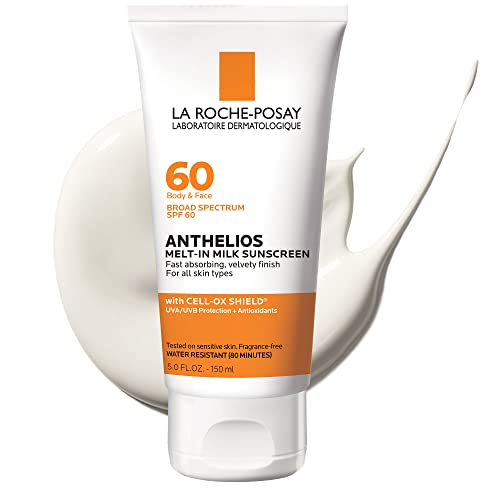
La Roche-Posay
Anthelios Melt-in Milk SPF 60
The European gold standard. Cosmetic-elegant SPF 60.
Best for: Body + face, water-resistant days

Japanese chemical SPF. Light, invisible, cheap.
Best for: Budget, oily skin, daily use

Korean SPF. Zero white cast. Lightweight.
Best for: Beach, sport, humid weather

Drugstore mineral SPF with ceramides. No frills.
Best for: Sensitive skin on a budget, body use
The best sunscreen for tretinoin users
Tretinoin thins the stratum corneum and ramps up photosensitivity. If you pair it with a harsh chemical SPF, you'll burn faster than normal. Stick to:
- Mineral or hybrid formulas
- Niacinamide or ceramides in the ingredient list
- Fragrance-free
- SPF 46+
The reapplication problem (and how to solve it)
The dirty secret of sunscreen science is that the SPF on the label lasts ~2 hours before breaking down. If you put it on at 7am and go to brunch at noon, you're not wearing sunscreen anymore.
Realistic solutions: a brush-on powder SPF for midday (Colorescience or Supergoop (Re)Setting), or a travel-size of your regular SPF for touch-ups.
Frequently asked
How often should I reapply sunscreen? +
Every 2 hours outdoors, immediately after swimming or heavy sweating. Indoors away from windows, one morning application is usually enough.
Is higher SPF actually better? +
SPF 30 blocks 97% of UVB, SPF 50 blocks 98%. The difference is small, but higher SPF gives a buffer for under-application, which basically everyone does.
Chemical or mineral sunscreen, which is better? +
Both work. Mineral (zinc oxide) is best for sensitive skin and rosacea. Chemical sunscreens are more cosmetically elegant and leave no white cast.
Do I need sunscreen indoors? +
Yes if you're near windows (UVA penetrates glass) or spend significant time in front of screens. Visible light and infrared also contribute to pigmentation.
How much sunscreen should I apply to my face? +
A quarter-teaspoon or about two finger-lengths. Most people use half that, which drops actual SPF by 50% or more.
Premium Beauty
The splurge layer
Vitamin C and SPF pair like nothing else, these are the luxury picks that earn their keep.
CurrentBody
Under $500LED Light Therapy Face Mask Series 3
750 LEDs and 6 wavelengths, chosen in the MyDose app.
Buy on Amazon →Dr. Dennis Gross
Under $500DRx SpectraLite FaceWare Pro
Rigid shell. 100 red + 62 blue LEDs. Sephora's bestseller.
Buy on Amazon →Omnilux
Under $500Men LED Face Mask
Omnilux's in-stock flexible LED face mask (the Contour Face is out of stock on Amazon).
Buy on Amazon →Therabody
Under $500TheraFace PRO
Microcurrent, red light and percussive therapy in one handheld. Replaces three single-purpose gadgets.
Buy on Amazon →Therabody
Under $500TheraFace PRO
Red light + microcurrent + percussive + cleansing. Sci-fi gadget.
Buy on Amazon →Augustinus Bader
Under $500The Cream
TFC8 tech. The one celebrities keep talking about.
Buy on Amazon →