Slugging Skincare: Complete Guide (2026)
Slugging, the Korean skincare trend of sealing your face with Vaseline, does it actually work? Here's the science, the best products, and who should.
Heads up: this post has affiliate links. We may earn a small commission if you buy something, at no extra cost to you. We only link to stuff we'd actually tell a friend about. Prices shown are approximate and change often; check the retailer for current pricing.
Slugging means sealing your last nighttime step with a thin layer of petrolatum, such as Vaseline, Aquaphor or CeraVe Healing Ointment, to slow overnight water loss. For plain hydration, Vaseline is the simplest pick. If you are using tretinoin or have irritated skin, Aquaphor or CeraVe Healing Ointment add soothing or ceramide ingredients and are the better choice. Skip it if your skin is oily, acne-prone or rosacea-prone.
Slugging spread from Korean skincare forums to TikTok. The idea is sound for the right skin type and a poor fit for the wrong one.
Vaseline vs Aquaphor vs CeraVe Healing Ointment
| Vaseline Original | Aquaphor Healing Ointment | CeraVe Healing Ointment | |
|---|---|---|---|
| Main ingredient | Petrolatum only | Petrolatum plus panthenol, glycerin and other additives | Petrolatum plus ceramides and hyaluronic acid |
| Best for | Simple, low-cost slugging | Chapped or irritated skin, tretinoin flaking | Compromised barrier, tretinoin users who want ceramides |
| Fragrance | Fragrance-free | Fragrance-free | Fragrance-free |
| Price tier | Budget | Budget to mid | Budget to mid |
| Watch out for | Can feel heavy | Contains lanolin, which some people react to | Slightly more ingredients to react to |
If you can use one, pick by skin state: healthy and dry means Vaseline, irritated means Aquaphor or CeraVe.
What slugging actually is
Slugging means applying a thin layer of occlusive (usually Vaseline, Aquaphor, or similar) as the final step of nighttime skincare. The occlusive creates a barrier preventing overnight water loss, so your skin stays hydrated all night. Name comes from the glossy, slug-like appearance on your face. Works because petrolatum is one of the most effective occlusives known: in a classic study it cut trans-epidermal water loss by more than 98%.
The science:
- Occlusives form a physical barrier on skin
- Petrolatum (Vaseline base) reduced trans-epidermal water loss by more than 98% in one frequently cited study (see Sources)
- Result: skin stays hydrated longer; products absorbed underneath stay active
Who slugging is good for
Slugging is ideal for: very dry skin, tretinoin users needing barrier protection, post-procedure recovery, dehydrated skin in winter, and anyone with compromised barrier. Slugging is NOT ideal for: oily skin, acne-prone skin (can trap oils), rosacea (can worsen with occlusion), or humid climates (overkill).
Good for:
- Very dry skin (especially winter)
- Tretinoin users (dramatic flaking reduction)
- Post-procedure recovery
- Dehydrated skin
- Mature skin with compromised barrier
Not good for:
- Oily skin
- Active acne (petrolatum can trap bacteria)
- Rosacea (trapping heat)
- Humid climates (overkill)
- Combination skin (selective application only)
Best slugging products

Vaseline
Original Petroleum Jelly
The classic. Pure petrolatum.
Best for: Dry skin, tretinoin users, budget slugging
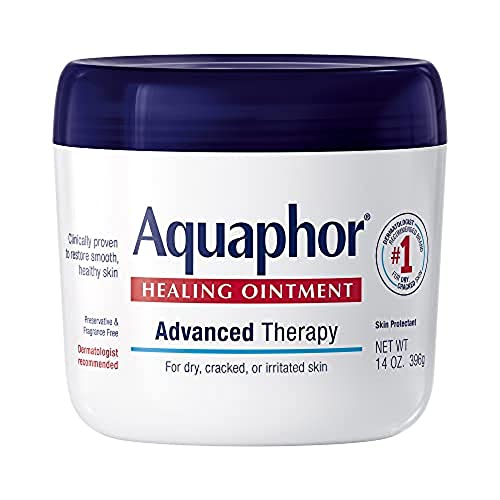
Aquaphor
Healing Ointment
Petrolatum + panthenol + glycerin. Slightly more active.
Best for: Tretinoin users, post-procedure, most skin types

CeraVe
Healing Ointment
Petrolatum + ceramides. Adds barrier repair actives.
Best for: Compromised barrier, tretinoin irritation
How to slug correctly
Slugging protocol: 1) Cleanse and tone. 2) Apply serums (vitamin C or hyaluronic acid if desired). 3) Apply moisturizer and wait 5-10 minutes. 4) Apply tretinoin (if using) and wait 20 minutes. 5) Apply thin layer of Vaseline over everything. Key: thin layer, not thick. Frequency: start with 2-3 nights per week and see how your skin responds.
Step-by-step:
- Cleanser (gentle, non-stripping)
- Toner (if using)
- Serums (vitamin C, hyaluronic acid, peptides)
- Moisturizer (wait 5-10 min)
- Tretinoin if using (wait 20 min)
- Thin layer Vaseline (pea-size for face)
Key rules:
- Thin layer: pea-size for full face
- Frequency: start at 2-3 nights per week
- Pillowcase: change or use a dedicated slugging pillowcase
- Not for face alone: neck, chest can benefit too
When slugging goes wrong
Slugging fails when: applied over dirty skin (traps bacteria causing breakouts), applied too thick (suffocating skin), used every night despite breakouts, applied over active actives that don’t need occlusion (BHA, AHA can degrade under occlusion). For best results: clean skin, thin layer, 2-3x per week max.
Slugging mistakes:
- Over dirty skin (traps bacteria, causes breakouts)
- Too thick (suffocates skin)
- Every night on skin that is breaking out
- Over AHA/BHA (acids can destabilize)
- Oily pillowcase (transfers back to skin)
Slugging + tretinoin: the killer combination
Tretinoin often causes flaking and irritation, and a layer of petrolatum over it can help reduce both by holding moisture in. Apply tretinoin, wait 20 min, then Vaseline. The sandwich method (moisturizer → tretinoin → slug) is even gentler for sensitive skin.
The slug+tret protocol:
- Cleanse
- Wait 20 min (skin dry)
- Apply tretinoin
- Wait 20 min (absorption)
- Apply thin Vaseline layer
Or the sandwich method for sensitive skin:
- Cleanse
- Apply moisturizer
- Wait 20 min
- Apply tretinoin
- Wait 20 min
- Apply Vaseline
When to stop slugging
Stop slugging if: you develop breakouts (petrolatum may be trapping bacteria), skin looks shinier but not actually healthier after 4 weeks, you live in humid climate year-round, you’re acne-prone, or you notice worsening rosacea/redness. Slugging is a tool, not a permanent routine addition.
Signs to stop:
- New breakouts appearing
- Skin looking overly shiny, not healthier
- Clogged pores becoming obvious
- Heat-rash or rosacea flare
- Humid climate (unnecessary)
The verdict
Slugging works for the right skin type (dry, tretinoin-user, winter) and fails for the wrong skin type (oily, acne-prone). It’s cheap and the occlusion science is solid, but it is a tool to use as needed, not a required daily step. The best slugging product for tretinoin users is CeraVe Healing Ointment; for general dry skin, Vaseline or Aquaphor.
Sources
- Ghadially R, Halkier-Sorensen L, Elias PM. Effects of petrolatum on stratum corneum structure and function. Journal of the American Academy of Dermatology, 1992.
This guide is researched, not medical advice.
Premium Beauty
Complement your slugging routine
Premium products that pair with the slug protocol.
CurrentBody
Under $500LED Light Therapy Face Mask Series 3
750 LEDs and 6 wavelengths, chosen in the MyDose app.
Buy on Amazon →Dr. Dennis Gross
Under $500DRx SpectraLite FaceWare Pro
Rigid shell. 100 red + 62 blue LEDs. Sephora's bestseller.
Buy on Amazon →Omnilux
Under $500Men LED Face Mask
Omnilux's in-stock flexible LED face mask (the Contour Face is out of stock on Amazon).
Buy on Amazon →Therabody
Under $500TheraFace PRO
Microcurrent, red light and percussive therapy in one handheld. Replaces three single-purpose gadgets.
Buy on Amazon →Therabody
Under $500TheraFace PRO
Red light + microcurrent + percussive + cleansing. Sci-fi gadget.
Buy on Amazon →Augustinus Bader
Under $500The Cream
TFC8 tech. The one celebrities keep talking about.
Buy on Amazon →Frequently asked
Can I slug every night? +
You can, if your skin is dry and stays clear. Start with 2-3 nights per week and add nights if skin tolerates it. Back off if you see breakouts. The claim that slugging makes skin dependent on it is a popular worry, but we have not seen evidence for it.
Is Vaseline safe for my face? +
Petrolatum is generally considered non-comedogenic and is widely used, but individual reactions vary. If you are pregnant or have a skin condition, ask your provider.
Will slugging cause breakouts? +
For acne-prone skin, yes, can trap bacteria. For dry/normal skin, unlikely. Test on a small area first if acne-prone.
Can I slug with oily skin? +
Selective slugging: only on dry areas (cheeks, neck) not the T-zone. Full-face slugging is typically too much for oily skin.
How long does it take for slugging to work? +
Skin feels more hydrated the next morning. Barrier improvement takes longer and depends on the cause of the dryness.
What if Vaseline is too heavy? +
Try Aquaphor (slightly lighter feel) or CeraVe Healing Ointment. Or try a thick ceramide cream, which is less occlusive but lighter.
Keep reading
All articles →guides
Is the Korean 10-Step Routine Still Worth It in 2026?
Korean 10-step routine in 2026: what still holds up, what's been debunked, and the 4 steps that actually matter. Plus the K-beauty products worth their.
guides
Latte Skin & Honey Skin: The 2026 Trends + How to Actually Get Them
Latte skin and honey skin are 2026's biggest skincare aesthetic trends. Here's what makes the look, the evidence-based products that actually achieve it.
tretinoin
Snail Mucin Guide 2026: Benefits, How Often to Use, Best Picks
What snail mucin (snail secretion filtrate) does for skin, how often to use it, morning or night, with acids and for acne, plus the best picks.
Premium Beauty
More Premium Beauty picks
If money isn't the object, these are our Premium Beauty favorites.
CurrentBody
Under $500LED Light Therapy Face Mask Series 3
750 LEDs and 6 wavelengths, chosen in the MyDose app.
Buy on Amazon →Dr. Dennis Gross
Under $500DRx SpectraLite FaceWare Pro
Rigid shell. 100 red + 62 blue LEDs. Sephora's bestseller.
Buy on Amazon →Omnilux
Under $500Men LED Face Mask
Omnilux's in-stock flexible LED face mask (the Contour Face is out of stock on Amazon).
Buy on Amazon →Therabody
Under $500TheraFace PRO
Microcurrent, red light and percussive therapy in one handheld. Replaces three single-purpose gadgets.
Buy on Amazon →Therabody
Under $500TheraFace PRO
Red light + microcurrent + percussive + cleansing. Sci-fi gadget.
Buy on Amazon →Augustinus Bader
Under $500The Cream
TFC8 tech. The one celebrities keep talking about.
Buy on Amazon →